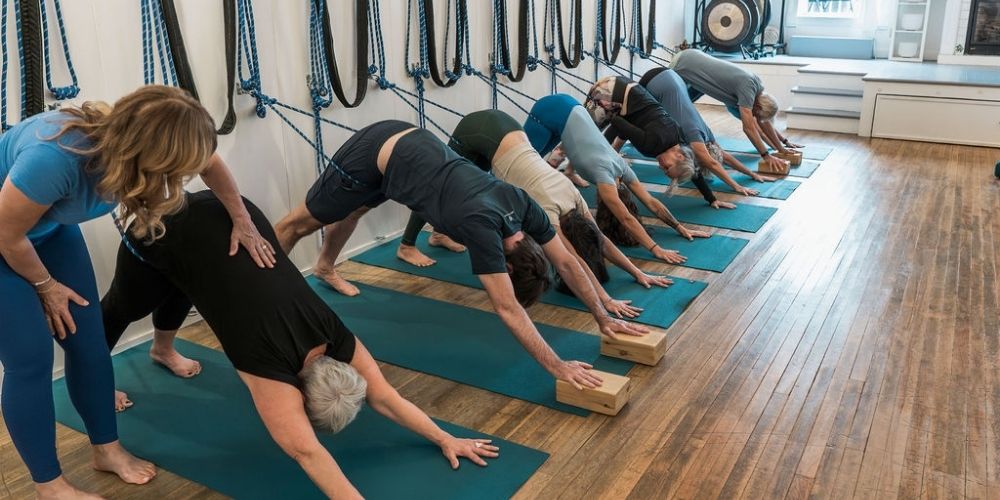

Every December, practitioners around the world pause to celebrate the birth of Yogacharya B.K.S. Iyengar, whose 107th year would be marked this December 14th. His legacy spans far beyond the boundaries of his own method. Today, yoga studios of nearly every style are equipped with blocks, bolsters, straps, chairs, and rope walls—props that make yoga both more accessible and more profound. Yet few practitioners outside the Iyengar tradition know where these tools were shaped, refined, and reimagined into what we recognize today.
This blog post is not about crediting Iyengar with “inventing” props—he never claimed that, and in fact openly acknowledged the ancient roots of supported practice. What he did do was transform the idea of support into an art and a science. He elevated props from improvised aids into precise instruments for learning, healing, and deepening.
Ancient Seeds, Modern Vision
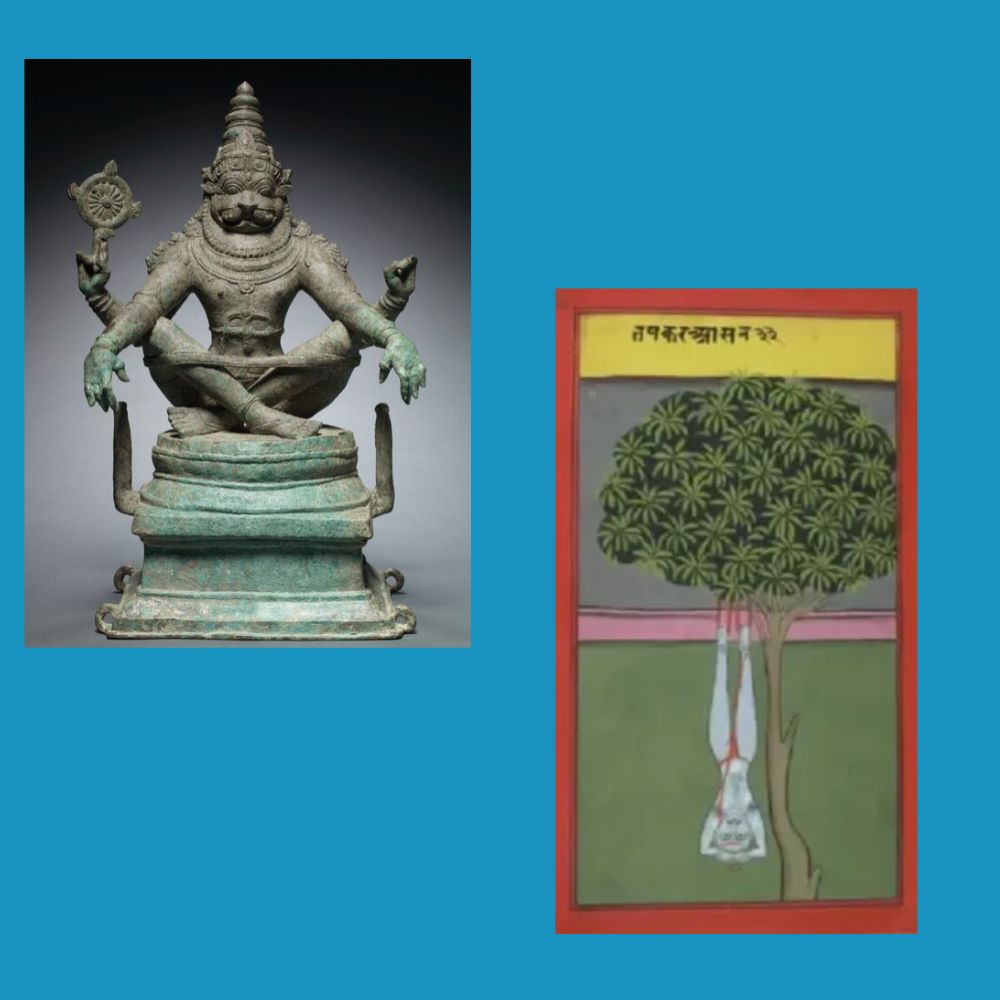
Iyengar often pointed out that images of yogis using trees, vines, and ropes existed long before him. The now-familiar rope wall, or yoga kurunta (“puppetry yoga”), grew from an image of a yogi dangling from a vine. Karunta comes from the Sanskrit word for puppets—a reminder that early practitioners used whatever was available to explore gravity, suspension, and alignment.
Ancient iconography also reveals the long-standing presence of supportive tools in yogic practice. A striking example is found in depictions of Yoga Narasimha, the serene, meditative form of the fierce deity Narasimha. In these images, a strap—called a yogapatta—is wrapped around the deity’s legs.
The yogapatta served two important roles:
- Practical support: It helped maintain a steady seated posture, such as yogapaṭṭāsana, allowing long periods of meditation and deep internal absorption.
- Symbolic meaning: It represents Narasimha’s shift from ferocity to tranquility after defeating Hiranyakashipu—an embodiment of inner stillness, spiritual balance, and disciplined surrender.
These ancient references mattered to Iyengar because they affirmed that supportive tools were not modern crutches, but enduring companions in spiritual practice.
What emerged through his work, then, was not invention in the sense of novelty, but reinvention, refinement, and creative mastery—the translation of timeless principles into tools that could meet modern students with real bodies and real limitations.
“I have not invented anything. I have only explored what was already there.” BKS Iyengar
Why Props? Service, Accessibility, and Precision
Props did not arise out of theory. They grew out of Iyengar’s desire to help students who could not access the classical asanas due to injury, age, constitution, or ability. He once said plainly:
“Raw students or patients could not derive maximum advantage… I thought that through indirect practice, with support, I could ignite interest in them to stay longer in each pose without pain.”
Through this simple but profound goal—to help people stay, breathe, and understand—a revolution began.
Longer stays with intelligent support improved circulation, refined respiration, and made the subtle actions of each posture perceptible. Props became vehicles for both accessibility and depth, not crutches but mirrors that revealed alignment, action, and awareness.
“Props are not signs of weakness. They are bridges—so the actions of the asana become clear, and the light of yoga can enter.”
B.K.S. Iyengar
The Humblest Beginnings
Before the sophisticated props we see today, there were buckets with blankets on top for backbends, hardcover books standing in for bricks, and everyday chairs used to support beginners.
- The original “backbender” (the dwi-pada viparita dandasana bench) was a barrel Iyengar once found and experimented with.
- The reason why seasoned practitioners still call blocks “bricks” is because they were bricks—literally sourced from brickmakers along the old Pune–Mumbai road.
- Belts began as ordinary household belts.
- Chairs were simply whatever home chairs were available.
As his experiments became more refined, Iyengar worked closely with local carpenters and craftsmen. He would perform a pose, ask them to sketch what they saw, then test the prototypes himself. He instructed where to shave off wood, where to add elevation, where to narrow or widen. Each prop went through stages of re-doing and reshaping until it served the body with precision.
Creativity That Never Stopped
What astonished many long-time students was the pace and continuity of his creativity. Even after decades of teaching, even into his late eighties and nineties, he was still developing new designs. Students returning to Pune year after year would find a mysterious new prop in the practice hall and ask, “What is this? Where did it come from?”
Iyengar understood his body intimately—its dimensions, its actions, its pathways of energy—and sought ways to transmit that understanding to others. His inspiration came from mythology, from anatomy, from the needs of his students, and from his own relentless practice.
For example, when working with students suffering from cardiac issues, he remembered the Mahabharata story of Arjuna’s bed of arrows for the dying Bhishma. That image inspired him to arrange bricks under the upper thoracic spine, supporting the nerves associated with the heart.
This was not mechanical innovation—it was mythic, intuitive, anatomical, and deeply compassionate.
“Yoga is for all. If you cannot reach the pose, the pose must reach you.” BKS Iyengar
Never Taking Credit—but Elevating the Field
Iyengar was sometimes called the “prop yogi,” or the “furniture yogi,” labels he accepted with humor. When someone insisted that “real yoga” should not rely on props, he would respond playfully yet pointedly:
“Teach a raw beginner full arm balance without a prop—even the wall and the teacher’s hand are props.”
He remained clear and humble: he did not invent props. He honored his teachers, honored ancient precedents, and understood himself as part of a continuum. But he unquestionably took the use of props to a higher level of refinement, integrating them into pedagogy, therapeutics, philosophy, and practice.
A Living Legacy
What Iyengar set into motion continues to evolve. Each generation inherits his principles and, through their own curiosity, expands upon them. Today’s yoga blocks, bolsters, rope walls, benches, and therapeutic setups—all ubiquitous worldwide—owe their precision and sophistication to the foundation he laid.
Though he never claimed ownership of the idea, the culture of prop-based learning, the system that supports it, and the possibilities it opened flowed unmistakably through him.
He showed us, through his boundless creativity and devotion, that yoga is not static. It grows, transforms, and adapts—just as he did, right up until his final year
A Gesture of Gratitude
The next time you pick up a block or a strap, take a moment to pause.
Offer a quiet word of thanks for the boundless curiosity and compassion that were the hallmarks of B.K.S. Iyengar. These tools—so ordinary in our studios today—carry the imprint of a man who dedicated his life to helping everybody experience the light of yoga.