
I sometimes say that I didn’t come to yoga because of a sore back or tight hamstrings — I came because of a broken heart. One day, I woke up to the quiet but insistent realization that I was unhappy. I was a workaholic in a job that didn’t nourish me, and I was married to an alcoholic. A small voice whispered, “There has to be more to life than this.”
Sharing your life with an addict means living on edge — half of the time walking on eggshells, the other half suppressing tears or rage. It was exhausting, and I didn’t recognize myself anymore. In 1998, in the midst of this unraveling, I found Iyengar Yoga — or perhaps it found me. That first class became my lifeline back to myself.
I had tried yoga before, the kind where you lie on the floor or stare at a candle — peaceful, perhaps, but not for someone who’d been hunched over books and deadlines all her life. When I stepped into that first Iyengar class, I had no idea what to expect. I certainly didn’t expect standing poses, meticulous instructions, or the waves of discomfort that came with confronting my own body and mind. Yet even though I didn’t “enjoy” that first class, I knew immediately: something profound was happening.
For the first time in years, I felt my feet. I could feel their weight, the earth beneath them, and the stability that had eluded me emotionally for so long. It was as if there was no separation between the floor and my being — grounded, alive, and awake all at once. I walked out of that class changed.
“Yoga teaches us to cure what need not be endured and endure what cannot be cured.” B.K.S. Iyengar
Iyengar Yoga as Therapy
People often ask if yoga therapy is only for those with “issues.” My answer is simple: we all have issues. Some are visible, others invisible. For me, yoga therapy was never about fixing something broken; it was about remembering my wholeness. Iyengar Yoga therapy, in particular, invites this kind of deep, intelligent inquiry. It isn’t about applying a posture as a prescription — it’s about observing, adjusting, and awakening awareness layer by layer.
Unlike physical therapy, which tends to focus on the mechanics of the body, Iyengar Yoga therapy reaches into the realm of consciousness. The props, sequences, and precision are not ends in themselves — they are doorways to inner stillness and balance. We don’t just stretch muscles; we refine perception. We cultivate viveka — discernment — and through that, healing emerges naturally.
“Health is a state of complete harmony of the body, mind, and spirit. When one is free from physical disabilities and mental distractions, the gates of the soul open.” BKS Iyengar
The Role of Philosophy
Iyengar Yoga therapy is inseparable from philosophy. Patanjali’s Yoga Sutras remind us that the purpose of yoga is the stilling of the fluctuations of the mind. That teaching has guided me in every practice, especially during times of turmoil. Through alignment and disciplined effort (tapas), I began to soften the internal noise — to quiet the anxiety, the self-criticism, and the fear that had defined me.
Therapy in this sense isn’t only about the body; it’s about cultivating sattva — clarity and balance — in the mind. Every pose, every breath becomes a philosophical act of self-study (svadhyaya). The more I learned to observe myself with compassion, the more I could extend that same compassion to others — students, loved ones, and even the parts of myself I once rejected.
The Power of Pranayama
At the height of my depressive anxiety, Pranayama became the bridge between darkness and light. It was, quite literally, my lifeline. After weeks of struggling through the physical challenges of asana, the quiet moments of breathwork felt like glimpses of grace. Pranayama wasn’t easy
— in fact, it was often the hardest practice — but within it, I experienced fleeting moments of wholeness.
That experience changed me. Pranayama taught me that healing doesn’t always mean comfort; sometimes it means facing the restlessness within and staying present long enough for the storm to settle. Over the years, I have come to see the breath as the most direct and profound form of therapy. It unites the physical, emotional, and spiritual dimensions of our being.
“The body is your temple. Keep it pure and clean for the soul to reside in.” BKS Iyengar
A Therapeutic Relationship with Practice
Iyengar Yoga therapy has given me tools to address specific conditions — my scoliosis, grief after my father’s passing, and the invisible imbalances that life brings. The therapeutic sequences are like letters of wisdom from those who came before us — teachers who understood that healing is personal and yet universal.
Through this method, I learned to view my spine not as a flaw but as a teacher. I learned that a “problem area” in the body is not an obstacle but an invitation to listen more deeply. Over time, my relationship with challenging poses changed too. Backbends that once felt cruel became explorations of vulnerability; standing poses that once exhausted me became stabilizing rituals.
“Yoga allows you to find an inner peace that is not ruffled and riled by the endless stresses and struggles of life.” BKS Iyengar
From Student to Teacher
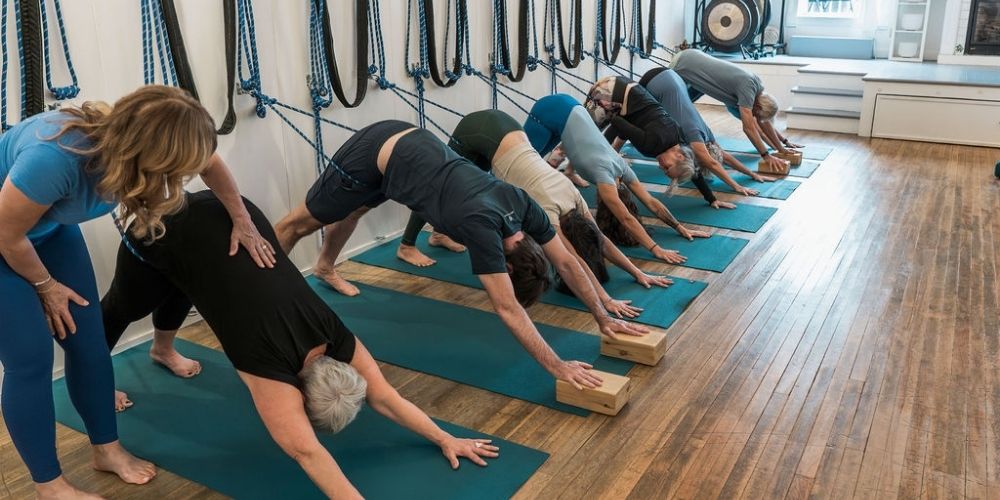
As a teacher now, I bring these lessons into every class. I don’t see yoga therapy as something separate from general practice. Every student, in every class, comes with a unique constellation of needs — physical, emotional, energetic. The aim of Iyengar Yoga therapy is not to diagnose, but to see. To observe what is present and respond with sensitivity.
In that sense, Iyengar Yoga therapy has profoundly informed both my personal and teaching practice. It reminds me that the practice is not about performance but about presence. Each student, like each asana, reveals something about our shared humanity — our longing to be whole, balanced, and at peace.
Closing Reflection
What began as a way to survive heartbreak became a lifelong path of transformation. Iyengar Yoga therapy has given me more than relief from pain or stress — it has given me a deeper relationship with myself. It continues to teach me that healing isn’t linear, and that true therapy is about connection — to breath, to body, to consciousness, and to life itself.
In time, that connection extended outward. As my inner world steadied, my outer world followed. I was able to move into a happy and healthy relationship, grounded in awareness and mutual respect — something I could not have imagined in those early years of struggle. Later, when I became pregnant, I experienced firsthand what it meant to be a student with specific needs. Practicing through the trimesters of prenatal yoga opened yet another layer of gratitude and understanding. My body became both teacher and student, showing me how adaptable, resilient, and wise it truly is.
That experience reaffirmed my belief that Iyengar Yoga therapy is for everyone — not only for those in pain or crisis, but for anyone seeking balance and wholeness at any stage of life. It continues to be my compass, my grounding, and my reminder that every breath offers the possibility of renewal.